

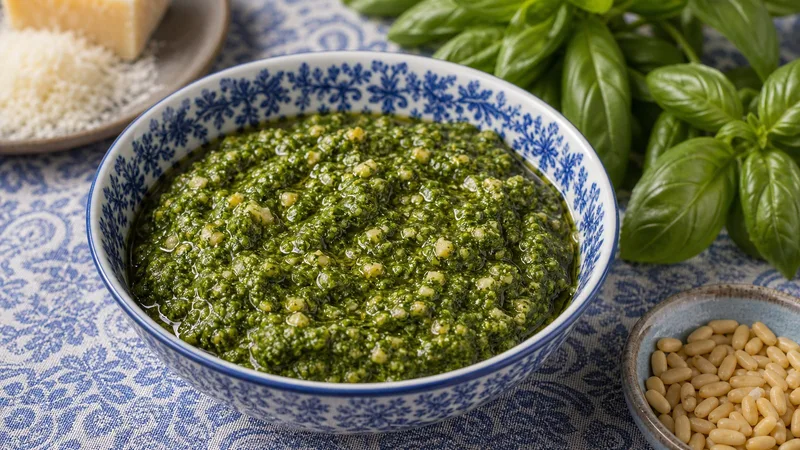
Homemade Pesto
To make homemade pesto, blend fresh basil, pine nuts, garlic, Parmesan cheese, and olive oil in a food processor until smooth. Season with salt and lemon juice. The whole process takes about 10 minutes and yields roughly 1 cup of sauce.
Pesto should taste like basil first. That seems obvious until you try versions dominated by raw garlic, stale nuts, or enough Parmesan to make the herbs file a missing-person report. This recipe keeps the proportions focused: fresh basil, toasted pine nuts, garlic, Parmesan, olive oil, lemon, salt, and black pepper, blended just enough to become a sauce without losing all texture.
Two small details make a large difference. Dry the basil completely, because extra water dilutes the flavor and dulls the color. And watch the pine nuts while they toast; they can move from fragrant and golden to tiny expensive charcoal pieces in the time it takes to answer a text. Pulsing the solids first also prevents the basil from getting overworked while everything else catches up.
Stream in the olive oil, finish with lemon and salt, and stop processing while the pesto still has some life to it. Spoon it over pasta, spread it on sandwiches, swirl it into soup, or put it on vegetables that were otherwise headed for a quiet evening. A thin layer of plastic wrap pressed directly onto the surface helps preserve that bright green color if you are storing it.
Ingredients
- 2 cups fresh basil leaves, packed (about 2 oz / 60g)
- 1/3 cup pine nuts
- 2 cloves garlic, peeled
- 1/2 cup freshly grated Parmesan cheese (about 1.5 oz)
- 1/2 cup extra-virgin olive oil
- 1/2 teaspoon kosher salt, plus more to taste
- 1 teaspoon fresh lemon juice
- Pinch of black pepper
Instructions
- 1Toast the pine nuts: Add pine nuts to a dry skillet over medium-low heat. Shake or stir constantly for 2–3 minutes until lightly golden and fragrant. Watch them the entire time — pine nuts go from perfectly toasted to ruined with the speed of a personal catastrophe. Remove immediately and let cool for 5 minutes.
- 2Prep the basil: Wash the basil leaves and dry them thoroughly with a clean kitchen towel or salad spinner. Wet basil will water down the pesto and dull the color.
- 3Pulse the solids: Add the cooled pine nuts, garlic cloves, and grated Parmesan to the food processor. Pulse 5–6 times until the mixture resembles coarse crumbs.
- 4Add the basil: Add the packed basil leaves to the food processor. Pulse 8–10 times until the basil is roughly chopped and incorporated with the other ingredients.
- 5Stream in the olive oil: With the food processor running on low, slowly pour the olive oil through the feed tube in a thin, steady stream. Process for about 30 seconds until the pesto is mostly smooth but still has some texture. Scrape down the sides once if needed.
- 6Season and finish: Transfer the pesto to a bowl. Stir in the lemon juice, salt, and black pepper. Taste and adjust — more salt if it needs brightness, more lemon if it tastes flat.
- 7Use immediately or store: If not using right away, press plastic wrap directly against the surface of the pesto before refrigerating to prevent browning.
Nutrition Information
Estimated per serving: 1 of 8 servings.
Estimated from the ingredients and quantities in this recipe using standard food-composition values. Brand choices, trimming, cooking loss, optional ingredients, and actual portion size can change the numbers. How we calculate nutrition estimates.
Pro Tips
- Don't skip toasting the pine nuts. Raw pine nuts taste fine. Toasted pine nuts taste intentional. This is a ten-second decision that changes the whole flavor.
- Grate your own Parmesan. The pre-grated stuff in a canister has cellulose added to prevent clumping, which also prevents it from melting into the sauce like it should. I learned this after a full year of slightly gritty pesto, which is not how I wanted to spend that year.
- If your pesto turns a sad, dark green within the hour, it oxidized — next time, blanch the basil for 15 seconds in boiling water, shock it in ice water, and dry it completely before blending. The color will hold for days. This sounds fussy. It is slightly fussy. It is also worth it when you're serving it to someone you want to impress.
Substitutions
Storage Instructions
Transfer pesto to an airtight container, press plastic wrap directly against the surface to prevent oxidation, and refrigerate for up to 5 days. For longer storage, freeze in an ice cube tray, then transfer frozen cubes to a zip-top bag and freeze for up to 3 months. Thaw individual cubes in the refrigerator or stir directly into hot pasta.
Make Ahead
Pesto can be made up to 3 days ahead and refrigerated with plastic wrap pressed against the surface. For best color and flavor, add the lemon juice and final seasoning just before serving. Alternatively, freeze the pesto before adding Parmesan — stir in freshly grated Parmesan after thawing for the cleanest flavor.
Frequently Asked Questions
Can I make Homemade Pesto ahead of time?
Make the pesto up to a few days ahead and refrigerate it in a tightly covered container with a thin film of olive oil over the surface to limit browning. Stir before using.
How do I store leftover Homemade Pesto?
Transfer pesto to an airtight container, press plastic wrap directly against the surface to prevent oxidation, and refrigerate for up to 5 days. For longer storage, freeze in an ice cube tray, then transfer frozen cubes to a zip-top bag and freeze for up to 3 months. Thaw individual cubes in the refrigerator or stir directly into hot pasta.
Can I freeze Homemade Pesto after cooking?
Yes. See the storage section on this page for exact freezing and thawing directions — most versions of Homemade Pesto freeze well for up to 2–3 months when cooled fully first and portioned into airtight containers.
Can I substitute ingredients in Homemade Pesto?
Yes. Tested adjustments on this recipe include pine nuts → walnuts or toasted almonds; Parmesan cheese → Pecorino Romano; and Parmesan cheese → nutritional yeast.
What's the most common mistake when making Homemade Pesto?
Don't skip toasting the pine nuts. Raw pine nuts taste fine. Toasted pine nuts taste intentional. This is a ten-second decision that changes the whole flavor.
How long does it take to make Homemade Pesto?
About 13 minutes from start to finish — including 3 minutes of active cooking.
More Like This

You Might Also Like


Finish With Dessert

Try this next
Blueberry Pie
View recipe →