

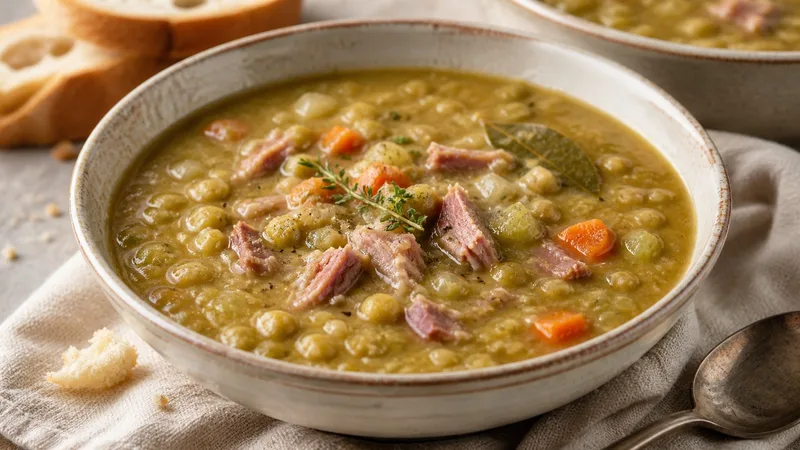
Split Pea Soup
To make split pea soup, simmer rinsed dried split peas with a ham hock, diced vegetables, and broth for 60 to 90 minutes until the peas break down into a thick, velvety soup. No blending required — the peas dissolve on their own with enough time and heat.
Split pea soup does not need cream to become velvety. Given enough time, the peas dismantle themselves. Dried green split peas simmer with a smoked ham hock, onion, carrots, celery, garlic, broth, bay leaves, thyme, smoked paprika, and black pepper until the peas collapse into the liquid and the pot turns thick almost by its own authority.
The ham hock is doing two jobs while that happens: seasoning the broth and slowly tenderizing enough meat to shred back into the finished soup. Wait until the end to add salt because both the hock and chicken broth may already be carrying plenty. If the soup gets thicker than you want during the 60–90 minute simmer, add broth or water in half-cup increments rather than trying to correct a cement mixer at the table.
Pull the hock, discard the skin and bone, return the meat, and taste again. The finished soup should be thick enough to coat the spoon but still clearly soup. It is smoky, earthy, soft around the edges, and exactly the sort of meal that makes crusty bread stop being optional and start becoming equipment.
Ingredients
- 1 pound (about 2 cups) dried green split peas, rinsed and picked over
- 1 smoked ham hock (about 1 to 1.5 pounds)
- 2 tablespoons olive oil or unsalted butter
- 1 large yellow onion, diced
- 3 medium carrots, peeled and diced
- 3 stalks celery, diced
- 4 cloves garlic, minced
- 8 cups low-sodium chicken broth
- 2 cups water
- 2 bay leaves
- 1 teaspoon dried thyme
- 1/2 teaspoon smoked paprika
- 1/2 teaspoon black pepper
- Salt to taste, added at the end
- Optional: crusty bread or crackers for serving
Instructions
- 1Rinse the dried split peas in a fine mesh strainer under cold water. Pick out any small stones or shriveled peas. Do not skip this step. Set aside.
- 2In a large heavy-bottomed pot or Dutch oven, heat the olive oil over medium heat. Add the diced onion, carrots, and celery. Cook, stirring occasionally, for 6 to 8 minutes until the vegetables have softened and the onion is translucent.
- 3Add the minced garlic and cook for 1 minute more, stirring constantly, until fragrant.
- 4Add the rinsed split peas, ham hock, chicken broth, water, bay leaves, thyme, smoked paprika, and black pepper. Stir to combine.
- 5Bring the soup to a boil over medium-high heat, then reduce the heat to low. Skim any foam that rises to the surface during the first 10 minutes.
- 6Partially cover the pot and simmer on low heat for 60 to 90 minutes, stirring every 20 minutes or so, until the split peas have completely broken down and the soup is thick. If the soup thickens too much, add water or broth in 1/2 cup increments.
- 7Remove the ham hock and set it on a cutting board to cool for 5 minutes. Remove and discard the bay leaves.
- 8Once the ham hock is cool enough to handle, pull the meat off the bone, discard the skin and bone, and shred or chop the meat into bite-sized pieces. Return the meat to the pot.
- 9Taste the soup and add salt as needed. Because the ham hock and broth both carry salt, you may need very little or none at all.
- 10Serve hot, with crusty bread alongside if you have it and someone who deserves it.
Nutrition Information
Estimated per serving: 1 of 6 servings.
Estimated from the ingredients and quantities in this recipe using standard food-composition values. Brand choices, trimming, cooking loss, optional ingredients, and actual portion size can change the numbers. How we calculate nutrition estimates.
Pro Tips
- Do not add salt until the very end. Salt added early can prevent split peas from softening properly, and you will spend an hour wondering what went wrong before realizing the answer has been in the Morton canister the whole time.
- Stir the pot more frequently in the last 30 minutes — split peas sink and scorch on the bottom faster than you'd expect, and a burned bottom will flavor the whole batch in a way no amount of optimism can fix.
- If you want a smoother texture, use an immersion blender to partially blend the soup after removing the ham hock meat. Blend about half and leave the rest chunky. This is optional but it makes the soup feel like it went to finishing school.
Substitutions
Storage Instructions
Let the soup cool completely before storing. Refrigerate in an airtight container for up to 5 days. The soup will thicken significantly when cold — stir in a splash of broth or water when reheating over low heat. Freeze in airtight containers or freezer bags for up to 3 months. Thaw overnight in the refrigerator before reheating.
Make Ahead
This soup is genuinely better the next day. Make it up to 2 days ahead, store covered in the refrigerator, and reheat gently on the stovetop over medium-low heat with a little added broth or water to loosen it back to your preferred consistency. The flavors deepen overnight in a way that makes you feel like you planned it all along.
Frequently Asked Questions
Can I make this ahead of time?
Yes. Split Pea Soup is a strong make-ahead recipe because it thickens as it rests. Cook it ahead, refrigerate it covered, then reheat gently with a little broth or water until it returns to the consistency you want.
How do I store the leftovers?
Let the soup cool completely before storing. Refrigerate in an airtight container for up to 5 days. The soup will thicken significantly when cold — stir in a splash of broth or water when reheating over low heat. Freeze in airtight containers or freezer bags for up to 3 months. Thaw overnight in the refrigerator before reheating.
Can I freeze it?
Yes. Cool the Split Pea Soup completely and freeze it in airtight containers or freezer bags. Thaw it in the refrigerator and reheat gently with a little broth or water because split peas thicken the soup as it sits.
Can I adjust it for what I have on hand?
Yes. Tested adjustments on this recipe include ham hock → 2 cups diced leftover ham or 4 strips thick-cut bacon; ham hock → smoked turkey leg or smoked turkey wings; and chicken broth → vegetable broth.
What's the most common mistake to avoid?
Do not add salt until the very end. Salt added early can prevent split peas from softening properly, and you will spend an hour wondering what went wrong before realizing the answer has been in the Morton canister the whole time.
Make It a Meal
Pair this recipe with a side, bread, and something sweet from the FAFO Kitchen.
More Like This

You Might Also Like

Finish With Dessert
Try this next
Pound Cake
View recipe →