

Technique
How Long to Bake Chicken Breast (Without Drying It Out)
Weight is on the package. Thickness is what actually decides how long it takes — and almost nobody measures the number that matters.
The Short Answer
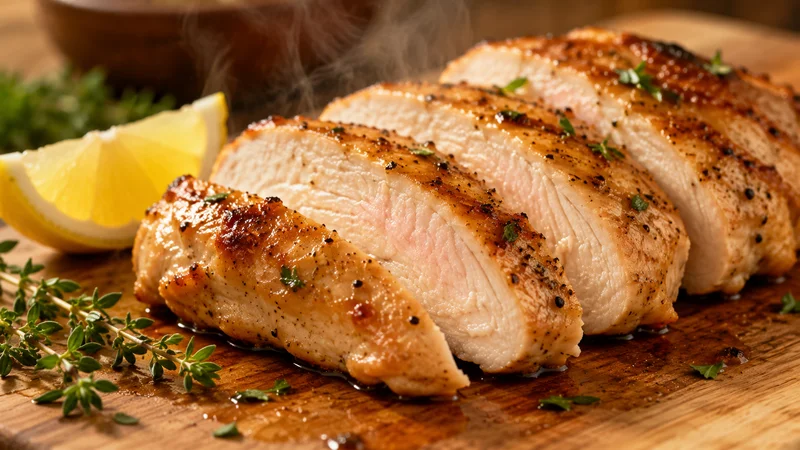
At 400°F, a standard 3/4-inch-thick chicken breast takes about 20 to 22 minutes. Pull it at 160–162°F and let it rest 5 minutes — carryover will carry it the rest of the way to a safe 165°F while staying noticeably juicier than pulling at 165°F directly.
Measure the thickest point, not the weight on the label. Two breasts of the same weight can differ in cook time by several minutes if one is thicker and shorter than the other.
Chicken breast has a reputation for being unforgiving, and the reputation is earned — but not for the reason most people think. It's not a hard piece of meat to cook. It's a piece of meat that people consistently cook using the wrong number.
Why Thickness Matters More Than Weight
Heat travels into meat from the outside in, at a rate that depends on how far it has to go — which is thickness, not total mass. A short, thick chicken breast and a long, thin one can weigh exactly the same on a scale and still need meaningfully different oven times, because the thick one has farther for heat to travel to reach the center.
This is why "6-ounce chicken breast, bake 25 minutes" instructions are unreliable — two 6-ounce breasts from the same package are rarely the same shape. One might be 3/4 inch thick at its center; another from the same tray might be a full inch. That quarter inch is worth several minutes of cook time.
The fix is simple: measure the thickest part of the breast with a ruler or your fingers before it goes in the oven, and use that number instead of the weight on the label.
Bake Time Calculator
How Long Do I Bake This?
Measure the thickest point of the breast. That's the number that actually matters.
Why 160°F, Not 165°F, Is the Number to Pull At
This trips people up because 165°F is drilled into everyone as the safe number for chicken, and it is — but it's the number the chicken needs to reach, not necessarily the number on the thermometer the moment it leaves the oven.
Just like a steak or a roast, a chicken breast keeps cooking for a couple of minutes after it comes out, from residual heat still migrating in from the hotter surface. Pull at 160 to 162°F and let it rest 5 minutes, and carryover alone will carry it the rest of the way to a safe 165°F — while spending less total time in the direct heat of the oven, which is the entire difference between juicy and dry with a lean cut like this.
If you'd rather not do the mental math, pulling at a straight 165°F is still completely safe. You'll just give up a little juiciness compared to using carryover deliberately.
The Method, Step by Step
- Pound to an even thickness if the breasts are uneven. A breast that's 1.5 inches at one end and 0.75 inches at the other will always overcook the thin end before the thick end catches up. A few whacks with a mallet between plastic wrap solves this in under a minute.
- Pat dry and season. Salt at least 15 minutes ahead if you have the time — see the brining section below for why that window matters.
- Preheat the oven fully before the chicken goes in. An oven that's still climbing to temperature adds unpredictable time and throws off every estimate in this article.
- Bake using the calculator's time as a starting point, then confirm with a thermometer — never time alone. Insert it into the thickest part, avoiding any bone if present.
- Pull at 160–162°F for the carryover method, or 165°F if you'd rather not rely on carryover.
- Rest 5 minutes, loosely tented, before slicing. Cutting into it immediately lets juices run out onto the board instead of staying in the meat.
The Single Biggest Cause of Dry Chicken
It isn't the oven temperature. It isn't the cut of meat. It's guessing at the time instead of confirming with a thermometer — cooking "until it looks done," which for chicken breast usually means several minutes past actually done, because visual cues on a lean, pale piece of meat are genuinely unreliable.
A thermometer removes the guessing entirely. It's the difference between a recipe that works every time and one that works when you get lucky.
Should You Brine It?
Not required, but genuinely worth it if you have 30 minutes to spare. A simple brine — about 4 tablespoons of salt dissolved in 4 cups of water, chicken submerged for 30 minutes to 2 hours — lets the meat absorb extra moisture before it ever sees the oven, which buys you real insurance against a slightly overshot cook time.
A quicker version: salt the chicken directly and let it sit uncovered in the fridge for at least 15 minutes, ideally an hour. It's not a full brine, but it's most of the benefit for none of the extra dishes.
Common Mistakes
Baking by weight instead of thickness
Weight on the label doesn't tell you how far heat has to travel to reach the center. Measure the thickest point instead.
Uneven breasts, same cook time
A breast that tapers from thick to thin will overcook on the thin end before the thick end is done. Pound to an even thickness, especially for larger breasts.
Not preheating fully
Starting the timer before the oven has actually reached temperature quietly adds several unaccounted-for minutes to every estimate.
Skipping the thermometer
Color and texture are unreliable tells on lean, pale chicken breast. A thermometer is the only check that actually confirms doneness.
Slicing immediately after baking
Even a short 5-minute rest keeps noticeably more juice in the meat than cutting straight into it.
Questions People Actually Ask
How long do you bake chicken breast at 400°F?
About 20 to 22 minutes for a standard 3/4-inch-thick breast, pulling at 160–162°F and resting 5 minutes to reach 165°F through carryover. Thicker breasts need more time; thinner ones need less — thickness is the number that actually determines timing.
What temperature should chicken breast be baked at?
400°F is the best balance of speed and moisture retention for most home ovens. Lower temperatures like 350°F take longer and can dry the meat out over that extended time; higher temperatures like 450°F cook fast but leave less margin for error.
Why is my baked chicken breast always dry?
Almost always from cooking past done without realizing it — guessing at time or color instead of confirming with a thermometer. Chicken breast is lean with very little fat to buffer overcooking, so even a few extra minutes shows up as dryness.
Can you pull chicken breast before it hits 165°F?
Yes, safely, if you pull at 160 to 162°F and rest it for 5 minutes — residual carryover heat will finish the job and bring it to a safe 165°F while it rests, typically with a juicier result than cooking all the way to 165°F in the oven directly.
Should chicken breast be pounded before baking?
If the thickness is uneven, yes. A breast that tapers significantly from one end to the other will overcook the thin end before the thick end finishes. Pounding to an even thickness solves this and also shortens overall cook time.
Try It In These Recipes
- Chicken Salad — built on perfectly baked, diced chicken breast
- Blackened Chicken Caesar Wraps
- Asian Chicken Crunch Salad
Hungry yet? Hundreds of tested recipes are waiting.
Browse All Recipes →