
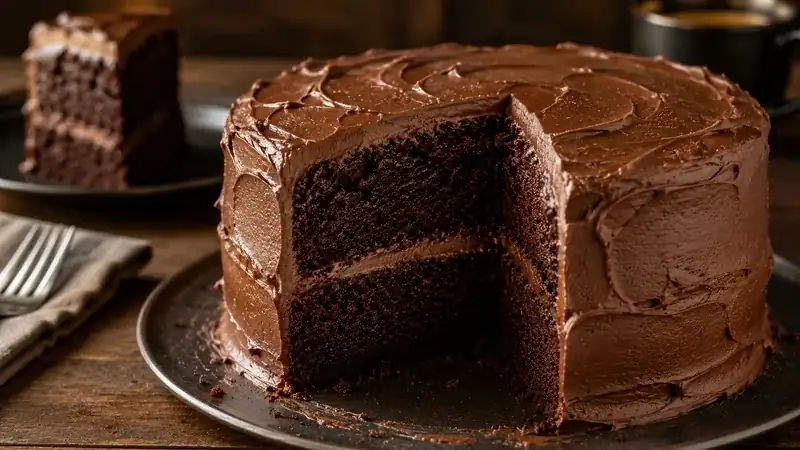
Chocolate Cake
To make chocolate cake, combine dry ingredients, whisk wet ingredients separately, mix together with hot coffee or water, then bake at 350°F for 30-35 minutes. The batter will look thin — that's correct — and the result is a moist, rich cake that sets up beautifully as it cools.
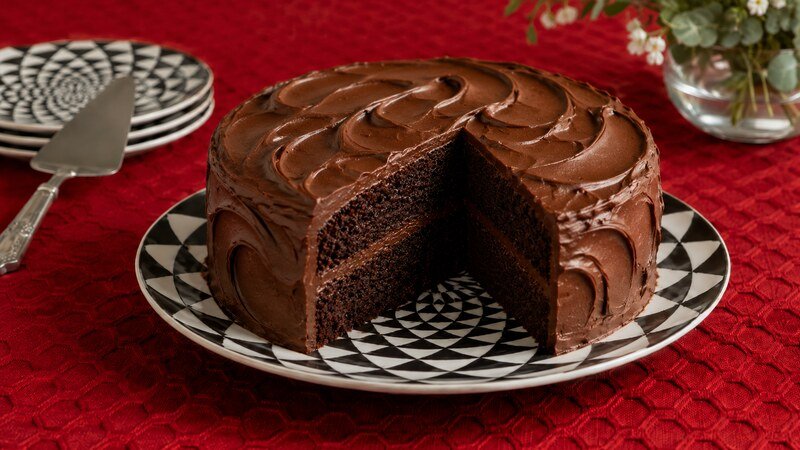
The batter for this chocolate cake is going to look too thin. That is not an emergency. Hot coffee is doing two useful things at once: loosening the batter so the cake bakes up moist and helping the Dutch-process cocoa taste darker and more chocolatey without making the finished cake taste like a mug of coffee. Buttermilk, oil, and eggs keep the crumb tender while two 9-inch pans turn the whole thing into a proper layer cake rather than a sheet-pan apology.
There are two moments worth being fussy about. Sift the cocoa so dry lumps do not survive into the batter, and line the bottoms of the pans with parchment. A cake layer sticking to the pan after you have already made buttercream is the baking equivalent of locking your keys in a running car.
Once the layers are completely cool, the chocolate buttercream brings softened butter, more cocoa, powdered sugar, heavy cream, vanilla, and salt into a thick, smooth frosting. "Completely cool" is doing real work in that sentence; warm cake melts buttercream and begins a slow landslide nobody can frost their way out of. Give it the time, stack the layers, and you get the deep chocolate cake you thought you were making when you bought the cocoa.
Ingredients
- 2 cups (240g) all-purpose flour
- 2 cups (400g) granulated sugar
- 3/4 cup (75g) Dutch-process cocoa powder, sifted
- 2 teaspoons baking soda
- 1 teaspoon baking powder
- 1 teaspoon fine salt
- 2 large eggs, room temperature
- 1 cup (240ml) buttermilk, room temperature
- 1 cup (240ml) strong brewed coffee, hot
- 1/2 cup (120ml) vegetable oil
- 2 teaspoons pure vanilla extract
- FOR THE CHOCOLATE BUTTERCREAM:
- 1 1/2 cups (340g) unsalted butter, softened
- 3/4 cup (75g) Dutch-process cocoa powder, sifted
- 4 cups (480g) powdered sugar, sifted
- 1/3 cup (80ml) heavy cream
- 2 teaspoons pure vanilla extract
- 1/4 teaspoon fine salt
Instructions
- 1Preheat your oven to 350°F (175°C). Grease two 9-inch round cake pans generously with butter or nonstick spray, then line the bottoms with parchment paper circles. Grease the parchment too. Do not skip the parchment — this is not a suggestion, it's a kindness to yourself.
- 2In a large bowl, whisk together the flour, sugar, sifted cocoa powder, baking soda, baking powder, and salt until fully combined and no cocoa lumps remain.
- 3In a separate bowl or large measuring cup, whisk together the eggs, buttermilk, vegetable oil, and vanilla extract until smooth.
- 4Pour the wet ingredients into the dry ingredients and stir until just combined. Then carefully pour in the hot coffee and mix until smooth. The batter will be very thin — thinner than you expect and probably thinner than you're comfortable with. This is correct. Trust it.
- 5Divide the batter evenly between the two prepared pans. Each pan should receive roughly the same amount; a kitchen scale helps here if you want even layers.
- 6Bake for 30-35 minutes, until a toothpick inserted in the center comes out with just a few moist crumbs (not wet batter). The edges will begin to pull away from the sides of the pan.
- 7Cool the cakes in their pans on a wire rack for 15 minutes, then turn them out, peel off the parchment, and cool completely on the rack — at least 1 hour — before frosting. Frosting a warm cake is how things go wrong fast.
- 8MAKE THE FROSTING: Beat the softened butter on medium-high speed for 3-4 minutes until pale and fluffy. Add the sifted cocoa and mix on low until incorporated. Add the powdered sugar one cup at a time, alternating with splashes of heavy cream, mixing on low between additions. Add the vanilla and salt. Once everything is incorporated, beat on medium-high for 2 minutes until light and spreadable. If it's too thick, add cream one tablespoon at a time. If it's too loose, add a little more powdered sugar.
- 9Place one cake layer on your serving plate or cake board. Spread about 1 cup of frosting evenly across the top. Place the second layer on top, press gently, then frost the top and sides. Start with a thin crumb coat if you want clean edges — refrigerate 20 minutes, then apply the final layer of frosting.
Nutrition Information
Estimated per serving: 1 of 12 servings.
Estimated from the ingredients and quantities in this recipe using standard food-composition values. Brand choices, trimming, cooking loss, optional ingredients, and actual portion size can change the numbers. How we calculate nutrition estimates.
Pro Tips
- Room temperature eggs and buttermilk matter more than you think. Cold dairy tightens the batter unevenly and can affect the rise. Set them out 45 minutes before you start.
- Hot coffee does not make this taste like coffee — it makes it taste more like chocolate. If you don't have coffee, use the same amount of very hot water. The coffee just deepens the cocoa, and the result is a significantly richer flavor.
- Do not open the oven before the 28-minute mark. The batter is thin enough that an early drop in temperature can collapse the center, and then you will have to eat your feelings along with a sunken cake, which is fine, but preventable.
Substitutions
Storage Instructions
Store frosted cake at room temperature under a cake dome or tightly covered for up to 3 days. Refrigerate after 3 days for up to 5 days total — bring slices to room temperature before eating, because cold buttercream is not the same thing as good buttercream. Unfrosted cake layers can be wrapped tightly in plastic wrap and frozen for up to 3 months; thaw overnight in the refrigerator before frosting.
Make Ahead
Bake cake layers up to 2 days ahead, wrap each layer tightly in plastic wrap, and store at room temperature. Frosting can be made up to 3 days ahead and refrigerated in an airtight container; re-beat with a hand mixer for 1-2 minutes before using to restore its texture. A fully assembled and frosted cake can be refrigerated overnight — bring to room temperature for at least 1 hour before serving.
Frequently Asked Questions
Can I make Chocolate Cake ahead of time?
Yes. Bake the cake layers ahead and let them cool completely before wrapping them. Frost and assemble the cake after the layers are fully cool so the frosting stays clean and the crumb does not tear.
How do I store leftover Chocolate Cake?
Store frosted cake at room temperature under a cake dome or tightly covered for up to 3 days. Refrigerate after 3 days for up to 5 days total — bring slices to room temperature before eating, because cold buttercream is not the same thing as good buttercream. Unfrosted cake layers can be wrapped tightly in plastic wrap and frozen for up to 3 months; thaw overnight in the refrigerator before frosting.
Can I freeze Chocolate Cake after cooking?
Yes. Freeze the fully cooled cake layers tightly wrapped, preferably before frosting. Thaw the wrapped layers before assembling and frosting the cake.
Can I substitute ingredients in Chocolate Cake?
Yes. Tested adjustments on this recipe include buttermilk → 1 cup whole milk + 1 tablespoon white vinegar; hot coffee → hot water; and Dutch-process cocoa → natural unsweetened cocoa.
What's the most common mistake when making Chocolate Cake?
Room temperature eggs and buttermilk matter more than you think. Cold dairy tightens the batter unevenly and can affect the rise. Set them out 45 minutes before you start.