
Breakfast Casserole
A breakfast casserole is made by layering cooked sausage, eggs, cheese, and bread or hash browns in a baking dish, then baking at 350°F for 45–55 minutes until set and golden. You can assemble it the night before and refrigerate it unbaked, then bake it fresh in the morning.
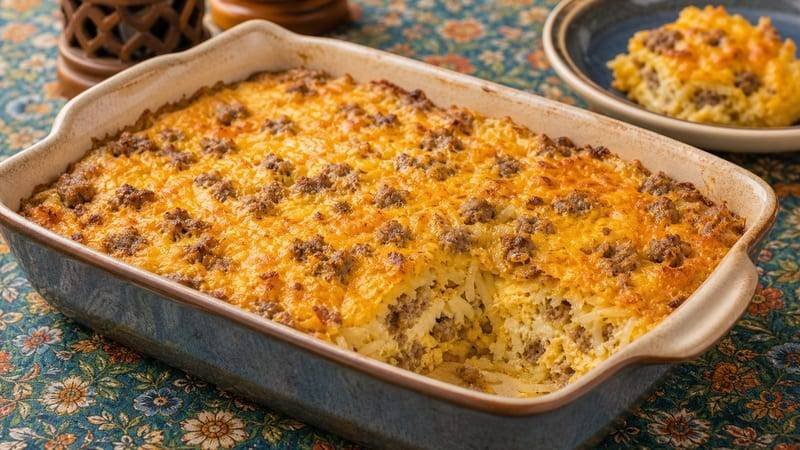
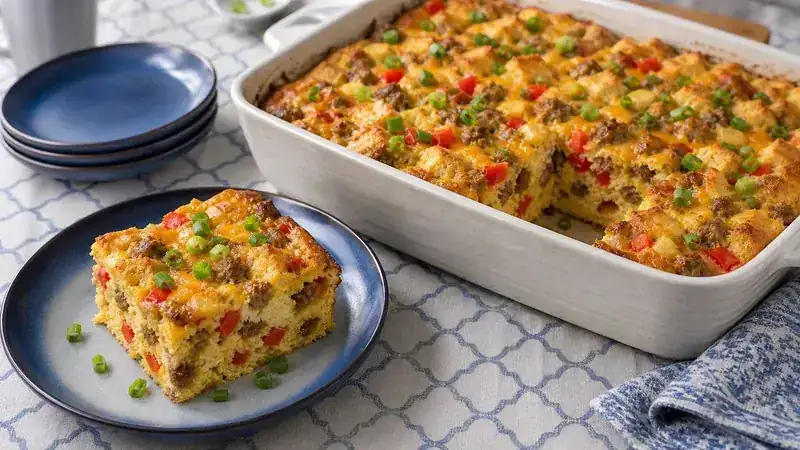
Feeding ten people breakfast sounds festive right up until you realize ten people can want eggs cooked ten different ways. A breakfast casserole removes that entire negotiation. Sausage, onion, red bell pepper, day-old bread, sharp cheddar, and a seasoned egg-and-milk mixture all go into one 9-by-13-inch dish, and the oven takes over from there. Nobody is standing at the stove flipping eggs while everyone else eats in shifts like a poorly managed diner.
Brown the sausage first, then use a little of its drippings to soften the onion and pepper. The bread goes on the bottom of the casserole, followed by sausage, vegetables, cheese, and the egg mixture. Give it at least 15 minutes before baking so the bread can absorb the custard; better yet, assemble the whole thing the night before and refrigerate it. At 350°F, it bakes until the center is set and no longer jiggles, with a final layer of cheddar melting across the top. Rest it for ten minutes before slicing so the pieces hold together. This is the kind of breakfast that lets the cook actually sit down, which may be the most luxurious ingredient in the entire pan.
Ingredients
- 1 pound bulk breakfast sausage (mild or hot)
- 1 medium yellow onion, diced
- 1 red bell pepper, diced
- 8 large eggs
- 2 cups whole milk
- 1 teaspoon garlic powder
- 1 teaspoon dry mustard
- 1/2 teaspoon salt
- 1/2 teaspoon black pepper
- 1/2 teaspoon smoked paprika
- 6 cups cubed day-old white sandwich bread (about 8–10 slices, 1-inch cubes)
- 2 cups shredded sharp cheddar cheese, divided
- 2 tablespoons unsalted butter, for greasing and sautéing
- 2 green onions, sliced, for garnish (optional)
Instructions
- 1Preheat your oven to 350°F. Grease a 9x13-inch baking dish generously with butter.
- 2In a large skillet over medium-high heat, cook the sausage, breaking it into crumbles, until browned and cooked through, about 7–8 minutes. Transfer to a paper towel-lined plate, leaving about 1 tablespoon of drippings in the pan.
- 3Add the diced onion and bell pepper to the skillet with the drippings. Sauté over medium heat until softened, about 5 minutes. Remove from heat.
- 4In a large bowl, whisk together the eggs, milk, garlic powder, dry mustard, salt, black pepper, and smoked paprika until fully combined.
- 5Spread the bread cubes evenly across the bottom of the greased baking dish. Top with the cooked sausage, then the sautéed onion and pepper mixture, then 1½ cups of the shredded cheddar.
- 6Pour the egg mixture slowly and evenly over the entire dish. Use a spatula or the back of a spoon to gently press the bread down so it absorbs the egg mixture fully. Let it sit for at least 15 minutes before baking, or cover tightly with plastic wrap and refrigerate overnight.
- 7If the casserole was refrigerated overnight, remove it from the refrigerator 20–30 minutes before baking to take the chill off.
- 8Sprinkle the remaining ½ cup of cheddar cheese over the top. Bake uncovered at 350°F for 45–55 minutes, until the center is set (it should not jiggle when you shake the pan) and the top is golden brown.
- 9Remove from the oven and let rest for 10 minutes before slicing. Garnish with sliced green onions if desired.
Nutrition Information
Estimated per serving: 1 of 10 servings.
Estimated from the ingredients and quantities in this recipe using standard food-composition values. Brand choices, trimming, cooking loss, optional ingredients, and actual portion size can change the numbers. How we calculate nutrition estimates.
Pro Tips
- Day-old bread is not a preference, it's a requirement — fresh bread turns to mush when it absorbs the egg custard. If your bread is fresh, spread the cubes on a baking sheet and toast them at 300°F for 10–12 minutes to dry them out.
- Press the bread down after you pour the egg mixture. I skipped this step for years because it felt unnecessary and every single time the top layer of bread came out like croutons with commitment issues.
- The casserole is done when the center doesn't jiggle and a knife inserted in the middle comes out clean. If the top is browning too fast before the center sets, tent it loosely with foil for the last 10–15 minutes.
Substitutions
Storage Instructions
Store leftovers covered tightly in the refrigerator for up to 4 days. Reheat individual slices in the microwave for 60–90 seconds or in a 325°F oven for 10–12 minutes until warmed through. The casserole can also be frozen after baking — wrap individual portions tightly in plastic wrap, then foil, and freeze for up to 2 months. Thaw overnight in the refrigerator before reheating.
Make Ahead
Assemble the entire casserole through step 6 (pouring and pressing the egg mixture), cover tightly with plastic wrap, and refrigerate for up to 18 hours. Remove from the refrigerator 20–30 minutes before baking, top with the remaining cheese, and bake as directed. Do not refrigerate longer than 18 hours — the bread begins to break down past that point and the texture suffers.
Frequently Asked Questions
Can I make this ahead of time?
Assemble the entire casserole through step 6 (pouring and pressing the egg mixture), cover tightly with plastic wrap, and refrigerate for up to 18 hours. Remove from the refrigerator 20–30 minutes before baking, top with the remaining cheese, and bake as directed. Do not refrigerate longer than 18 hours — the bread begins to break down past that point and the texture suffers.
How do I store the leftovers?
Store leftovers covered tightly in the refrigerator for up to 4 days. Reheat individual slices in the microwave for 60–90 seconds or in a 325°F oven for 10–12 minutes until warmed through. The casserole can also be frozen after baking — wrap individual portions tightly in plastic wrap, then foil, and freeze for up to 2 months. Thaw overnight in the refrigerator before reheating.
Can I freeze it?
Yes. See the storage section on this page for exact freezing and thawing directions — most versions of Breakfast Casserole Recipe freeze well for up to 2–3 months when cooled fully first and portioned into airtight containers.
Can I adjust it for what I have on hand?
Yes. Tested adjustments on this recipe include bulk breakfast sausage → diced ham or cooked and crumbled bacon; white sandwich bread → cubed French bread, sourdough, or croissants; and whole milk → half-and-half or evaporated milk.
What's the most common mistake to avoid?
Day-old bread is not a preference, it's a requirement — fresh bread turns to mush when it absorbs the egg custard. If your bread is fresh, spread the cubes on a baking sheet and toast them at 300°F for 10–12 minutes to dry them out.
Make It a Meal
Pair this recipe with a side, bread, and something sweet from the FAFO Kitchen.