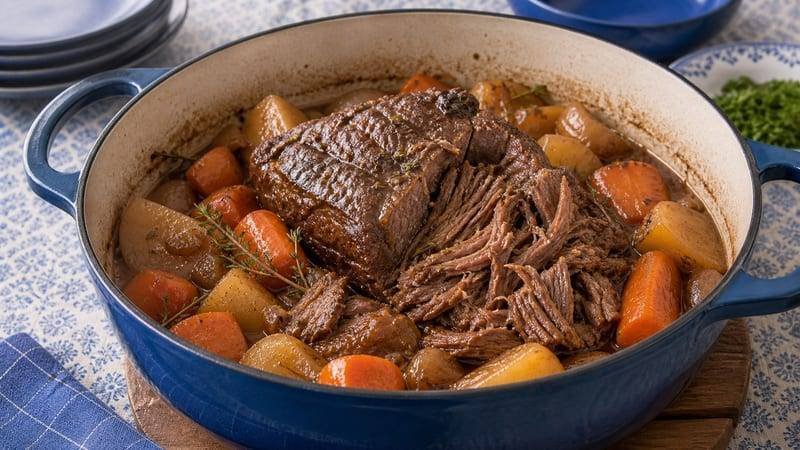
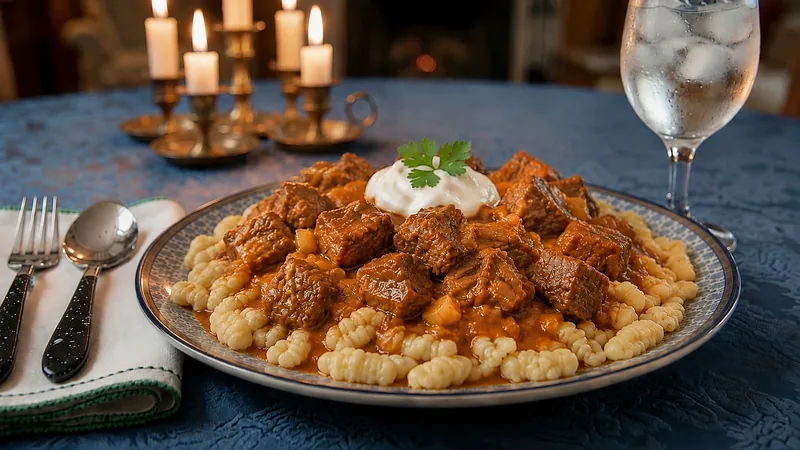
Creamy paprika-orange Hungarian goulash with tender beef, served over homemade spaetzle with a swirl of sour cream

Hungarian Goulash with Homemade Spaetzle

Save, rate, and make it yours

Optional account features. You can still read every recipe without logging in.

Your rating
Quick Answer

Hungarian goulash is a rich paprika-and-beef braise that sits somewhere between a soup and a stew. Chuck roast is slow-cooked with sweet Hungarian paprika, caraway, and red wine until fork-tender, then finished with sour cream stirred right into the pot — that is what gives it its signature creamy, paprika-orange color — and ladled over tender homemade spaetzle.

Jump to Recipe

This is one of those recipes that feels less like a meal and more like a family tradition. Hungarian goulash lands somewhere between a soup and a stew — rich, deeply savory, and built on the unmistakable flavors of sweet paprika, caraway, garlic, and slow-braised beef.

One thing I've learned about goulash is that every Hungarian family seems to make it a little differently, and every one of them is convinced their version is the authentic one. To me that means they're all authentic, as long as they honor the classic Hungarian flavors that make this dish so special.

This one is especially meaningful to me because it was passed down from my stepfather, Andrew W. Sr. Andrew was 100% Hungarian, raised on a farm in North Dakota after he was orphaned as a baby — and he believed to his dying day that he wasn't just Hungarian, but Hungarian royalty, the rightful heir to the throne. "The King of Hungry," my mom always called him. He'd say it with a completely straight face, like a man defending a crown.

Regardless of the disgruntled ramblings, the man could cook. His Hungarian goulash and his chicken paprikash — both served over homemade spaetzle — would make your taste buds do things you didn't know were possible. More than worthy of any holiday. He only made them on special occasions, and the smell filling the house was always the sign that something memorable was about to hit the table. After he passed, I was lucky enough to inherit his recipe, and I've kept it as close to his tradition as I can — right down to that big spoonful of sour cream stirred in.

Prep30 minutes
Cook3 hours 30 minutes
Total4 hours
Serves6 servings
DifficultyMedium

Ingredients

Servings

For the Goulash

  • 1 1/2 tablespoons vegetable oil
  • 6 large onions, sliced
  • 3 red bell peppers, seeded and diced
  • 1 1/2 heads garlic, cloves peeled and halved
  • 3/4 cup sweet Hungarian paprika
  • 1 1/2 teaspoons caraway seeds
  • 4 1/2 pounds chuck roast, trimmed and cut into 1-inch cubes
  • 6 carrots, chopped
  • 4 1/2 cups Hungarian red wine (or another dry red wine)
  • 4 bay leaves
  • 1 1/2 teaspoons salt
  • 3 tablespoons red wine vinegar

For the Spaetzle

  • 1 1/2 cups whole wheat flour
  • 1 1/2 tablespoons cornstarch
  • 3/8 teaspoon salt
  • Freshly ground black pepper, to taste
  • 3 eggs
  • 3/4 cup milk
  • 1 1/2 teaspoons ground nutmeg (or freshly grate about 3/4 of a whole nutmeg)

For Serving

  • 1 1/2 cups sour cream (most stirred into the sauce, the rest for topping)

Instructions

  1. 1Preheat your oven to 325°F (160°C). If your oven has a convection setting, turn it on.
  2. 2Heat the vegetable oil in a large Dutch oven over medium-low heat. Add the sliced onions, diced bell peppers, and garlic. Cook slowly for about 10 to 12 minutes, stirring occasionally, until the vegetables are very soft and fragrant but not browned.
  3. 3Reduce the heat to low and stir in the sweet paprika and caraway seeds. Let them cook for 1 to 2 minutes so the spices bloom and release their full flavor. Keep the heat low — paprika scorches and turns bitter quickly.
  4. 4Add the beef cubes, carrots, red wine, bay leaves, and salt. Stir everything together and bring the mixture just to a gentle simmer.
  5. 5Cover the Dutch oven and transfer it to the oven. Bake for about 3 hours, or until the beef is fork-tender and the broth has become rich and deeply flavored.
  6. 6Remove the bay leaves and stir in the red wine vinegar. The vinegar brightens the stew and balances the richness of the beef and paprika.
  7. 7While the goulash finishes, make the spaetzle. In a large bowl, whisk together the whole wheat flour, cornstarch, salt, black pepper, and nutmeg. In a separate bowl, whisk the eggs and milk until smooth, then pour the wet ingredients into the dry and stir until a thick, sticky batter forms. Let the batter rest for 15 minutes so the flour fully hydrates — this makes for tender, chewy spaetzle.
  8. 8Bring a large pot of generously salted water to a boil. Place a spaetzle maker, or a colander with large holes, over the pot and press the batter through so small dumplings fall directly into the water. No spaetzle maker? A box grater held over the pot works well — press the batter through the largest holes.
  9. 9The spaetzle cook quickly. They sink at first, then float to the surface after 1 to 2 minutes. Stir gently to keep them from sticking, remove them with a slotted spoon, and transfer to a bowl. Repeat with the remaining batter.
  10. 10Just before serving, temper the sour cream so it doesn't curdle: in a bowl, whisk it together with two ladles of the warm goulash broth until smooth. Off the heat, stir most of the tempered sour cream back into the pot until the sauce turns creamy and a rich paprika-orange. Reserve a few spoonfuls for topping.
  11. 11Divide the spaetzle among six bowls or plates. Ladle the creamy goulash over the top, making sure each serving gets plenty of tender beef and paprika-orange sauce. Finish each bowl with a dollop of the reserved sour cream. This one tastes even better the next day, once the flavors have had time to deepen — exactly the way my stepfather always preferred it.

Pro Tips

  • That signature creamy, paprika-orange color comes from two things working together: a generous amount of sweet Hungarian paprika, and the sour cream stirred right into the sauce at the end. Temper the sour cream first — whisk it with a couple of ladles of warm broth — and stir it in off the heat so it turns silky instead of curdling.
  • Keep the heat low when you add the paprika. It only needs a minute or two to bloom, and high heat will scorch it and turn the whole pot bitter.
  • Don't rush the vegetables and don't brown them. You want the onions and peppers soft and sweet so the broth stays clean and paprika-red, not caramelized and muddy.
  • Rest the spaetzle batter the full 15 minutes. It lets the flour hydrate so the dumplings come out tender and chewy instead of tough.
  • Stir in the vinegar right at the end, off the heat. Added early it cooks off; added last it brightens the whole dish and cuts the richness.

Substitutions

sweet Hungarian paprika → regular sweet paprika in a pinch It's the heart of the dish, so it's worth seeking out. Regular paprika is milder and less sweet. Don't swap in hot or smoked paprika for the full amount — it will overpower everything.
chuck roast → beef short rib or brisket Any well-marbled braising cut works. Avoid lean cuts like round or sirloin — they turn dry and stringy over a long braise.
whole wheat flour (spaetzle) → all-purpose flour All-purpose makes a lighter, more classic dumpling. Whole wheat is the family version with a nuttier flavor and more chew.
spaetzle maker → colander with large holes or a box grater Hold either over the boiling water and press the batter through. No special equipment required.

Storage Instructions

Store leftover goulash in an airtight container in the refrigerator for 3 to 4 days. It genuinely tastes better on day two once the flavors have had time to deepen. Reheat gently on the stove, adding a splash of water or wine if it has thickened too much. Store any leftover spaetzle separately and reheat them in a little butter.

Make Ahead

The goulash can be made 1 to 2 days ahead and reheated gently before serving — this is a great dish to cook the day before a holiday. For the best texture, cook the spaetzle fresh right before you serve.

Freezing

The goulash freezes well for up to 3 months. Cool it completely, portion into airtight containers or freezer bags, and thaw overnight in the refrigerator before reheating gently. Spaetzle are best fresh, but can be frozen separately and reheated in butter.

Frequently Asked Questions

Can I make Hungarian goulash ahead of time?

Yes, and it is arguably better for it. The goulash can be made 1 to 2 days ahead and reheated gently on the stove — the paprika and beef flavors deepen overnight. Cook the spaetzle fresh right before serving for the best texture.

What cut of beef is best for goulash?

Chuck roast is ideal. It is well-marbled with connective tissue that breaks down over a long, slow braise into rich, fork-tender beef. Lean cuts like round or sirloin will turn dry and stringy, so avoid them for this dish.

I don't have a spaetzle maker — what can I use?

A colander or perforated pan with large holes works well held over the boiling water. A box grater held over the pot, pressing the batter through the largest holes, also works surprisingly well.

Can I use regular paprika instead of sweet Hungarian paprika?

Sweet Hungarian paprika is what gives real goulash its color and gentle sweetness, so it is worth seeking out. Regular paprika will work in a pinch but tastes milder and flatter. Do not substitute hot or smoked paprika for the full amount — a large quantity of either will overpower the dish.

Why is there whole wheat flour in the spaetzle?

That is how this family version is made — whole wheat flour gives the spaetzle a nuttier flavor and a little more chew. If you want a lighter, more classic dumpling, use all-purpose flour instead.

Can I freeze Hungarian goulash?

The goulash freezes well for up to 3 months. Cool it completely, portion into airtight containers or freezer bags, and thaw overnight in the refrigerator before reheating gently. Spaetzle are best fresh, but can be frozen separately and reheated in butter.

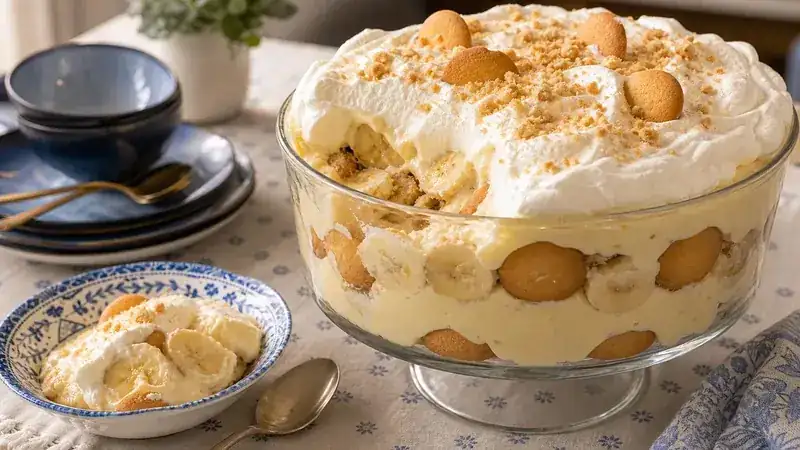
Finish With Dessert

Banana Pudding

Try this next

Banana Pudding

View recipe →

Lila, FAFO Kitchen recipe developer

Lila

The recipes here come from real home cooking — the kind that gets made, adjusted, and made again over the years until it is worth putting on the table. We write them down and tune them so they work in your kitchen too.

Something not working? Tell Lila.